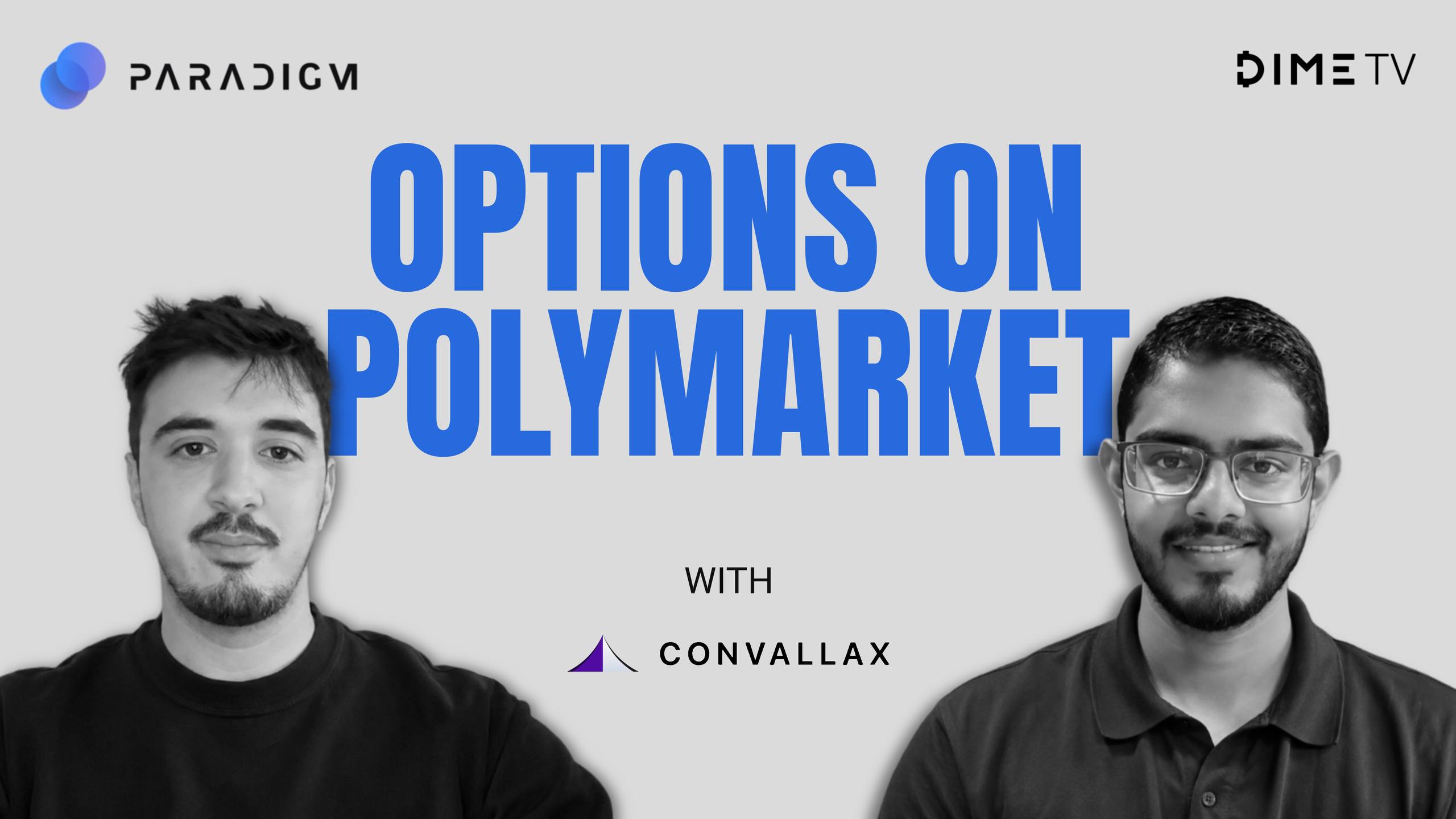
On a prediction market, a trader who is ninety percent certain and a trader flipping a coin put up exactly the same money for exactly the same exposure. There is no dial for conviction. Every other asset class solved that a long time ago, and the reason prediction markets have not is stranger and more structural than it looks. DimeTV guest Kushal Mungee, CEO and co-founder of Convallax, is building the options layer that fixes it.
Watch the full episode. Convallax founder Kushal Mungee on DimeTV: why leverage on prediction markets keeps breaking, how options fix it, and where the pricing gets hard. Or read the highlights below.
This isn't a how-to on trading mechanics. If you want the foundations, our options series covers calls, puts and premiums, the Greeks, and how implied volatility is priced. This is about what happens when you point that machinery at an asset that can only ever trade between zero and one: why leverage keeps breaking, how you price an option on a probability, and why the whole thing has to run on RFQ.
Featured guest
Kushal Mungee, CEO and co-founder of Convallax, an options exchange for prediction markets. He studied math and economics at Northwestern, traded as a quant at Virtu, and spent a year at a hedge fund applying reinforcement learning to options. His co-founder was an FX options trader at Morgan Stanley before starting a crypto fund that was later acquired. Convallax ran testnet markets through the World Cup and is preparing for mainnet. Kushal joined Paradex on DimeTV to explain the layer he thinks prediction markets are missing.
From the episode
Conviction has no price. Certainty and a coin flip buy identical exposure per dollar. The only lever is more cash.
Leverage keeps breaking because the underlying gaps. Prices jump between zero and one, so liquidation engines cannot unwind in time.
Options are the primitive that survives it. The buyer's maximum loss is the premium, so there is no liquidation engine to fail.
Pricing is an open research problem. Black-Scholes assumes an unbounded underlying. A probability is bounded by definition.
The options layer runs on RFQ, because strikes times expiries times underlying markets is far too many books to quote.
Why can't you get leverage on Polymarket?
Start with the gap, because it is easy to miss how strange it is. Every other market gives you a way to size up when you are confident. Equity traders reach for short dated options. Crypto traders reach for perpetuals, which now trade orders of magnitude more volume than the spot markets underneath them. On a prediction market, if you are certain and someone else is guessing, you both hand over the same hundred dollars for the same hundred dollars of exposure.
"You don't have a way to express that greater level of conviction or leverage. The only way to get more exposure to that outcome is to put up more cash."
— Kushal Mungee, CEO and co-founder, Convallax
People have tried to fix this. The obvious routes are lending against a position or building a perpetual future on the outcome, and Kushal's argument is that both run into the same wall: gap risk. A prediction market share does not drift, it jumps. News lands, a game turns, a market resolves, and the price moves from something to almost nothing in a single step.
Anyone who has watched a liquidation engine meet a violent move already knows why that matters. Forced unwinds need something to unwind into, and in a gap there is nothing on the other side. It is the same failure mode behind scam wicks and unfair liquidations in crypto, and the reason auto-deleveraging breaks down exactly when it is needed most. On prediction markets the problem is not an edge case, it is the normal behaviour of the asset. Which is why Kushal describes leverage here as still largely unsolved, despite being an obvious thing to want.
What do options actually change?
Options sidestep the problem rather than solving it head on. When you buy a call or a put, your maximum loss is the premium you paid, and it is paid up front. There is no maintenance margin, no health factor, no engine that has to sell you out of a position at exactly the moment nobody wants to buy it. The structure is safe against gapping because it never has to react to a gap at all.
The leverage arrives through the price instead. A Polymarket YES share sitting around forty cents gives you a straightforward payoff if the outcome hits. An out of the money call on that same outcome might cost a fraction of that, so the same capital buys far more exposure to the move you actually believe in. In their World Cup testnet markets, with Spain trading around fifteen cents at the start of the tournament, calls struck higher up were changing hands for a cent or two. Kushal frames it as a multiples improvement in exposure per dollar for the trader with real conviction, with the downside capped at the premium.
New to how any of this works? Our plain-English guides cover what options are and how to read an options chain. You can trade BTC and ETH options with deep liquidity, around the clock, from a single self-custodial account on Paradex.
Leverage is the headline, and it is the least interesting consequence. Once calls and puts exist on an outcome, everything options do in every other market becomes available to prediction market traders for the first time.
Hedging. Kushal's example is uncomfortably relatable: you backed a team to win the World Cup months ago, they made the semi-final, and you are now watching a match you cannot afford to lose. Without options you either sit through it or sell. With puts on that outcome, you insure the position and keep the upside, the same way a holder insures a portfolio.
Yield on positions you already hold. If you own YES shares you can write calls against them and collect premium, which is the covered call structure holders use in every other asset class, arriving here for the first time.
Volatility as its own trade. This is the deepest one. You can have a view on how much a probability will move without having a view on which way it goes. A contested election, a tournament where the favourite looks fragile, a market about to meet new information: those are volatility trades, structurally similar to buying a straddle into a scheduled data print, and today there is no way to express them.
Who this is actually for
Convallax's own analysis of the user base points at two groups: active traders doing meaningful quarterly volume, and a smaller cohort of professional traders. By their estimates those groups together drive the large majority of platform volume despite being a small minority of accounts. These are the users who already think in terms of position sizing and hedging, and who currently have the fewest tools available to them. Figures are Convallax's internal research rather than published platform data.
There is a quieter problem the same instruments solve. Get large enough on a prediction market and the book is too thin to exit without moving the price against yourself, which means size, an edge almost everywhere else, becomes a liability. It is the prediction market version of the transparency trap: everyone can see the whale, and the whale has nowhere to go. Options let a large holder adjust exposure without ever touching the underlying.
How do you price an option on something bounded between zero and one?
Here is where it stops being a product question and becomes a research question. Black-Scholes, the model underneath most options pricing, assumes an underlying that can wander anywhere from zero to infinity. A probability cannot. It is trapped between zero and one, it converges hard toward one end as an event resolves, and it gaps rather than diffusing. Kushal is blunt that the standard toolkit does not transfer cleanly, and that includes the Greeks that traders lean on everywhere else.
What market makers reach for instead, in his account, falls into three families: modelling the outcome with a beta distribution, which is naturally bounded between zero and one; using a bounded adaptation of Black-Scholes that maps the probability into a continuous space with a logit transformation, prices it there, and maps it back; or running simulations to estimate the expected payoff at expiry directly. None of these is settled practice. He describes it as a genuinely hard quantitative problem that the early market makers are working out in real time.
Because pricing is immature, the platform itself carries guardrails. Quotes falling outside a defensible range get rejected rather than filled, which protects both sides from a mispriced series being lifted before anyone notices. That is a design choice you make when you know the models are still young.
Where does implied volatility come from?
One of the more interesting things in the conversation is a thing that does not exist yet. In equities and crypto, implied volatility is a public benchmark. Crypto has its own VIX equivalent, and specialist firms have built entire businesses on modelling the surface. For event probabilities there is no equivalent, because there has been no options market to back one out of.
Kushal expects that to change as the layer matures, producing something like an implied volatility surface across strikes and expiries for each underlying event. What that would give traders is a way to compare contestedness across markets: not just what the crowd thinks the probability is, but how confident and how stable that estimate is. He notes his team is among the first researching the problem, and that quant desks are beginning to look at it internally.
Why does the options layer have to run on RFQ?
This is where Convallax's path converges with Paradigm's founding thesis, and it happens the same way it did for every options venue before it. The problem is combinatorial. Take the number of underlying prediction markets, multiply by every strike a trader might want between zero and one, multiply again by every expiry between now and resolution. Anyone who has read a single options chain can picture how fast that grows. Spread market maker capital across all of those books and each one is close to empty.
Request for quote inverts it. Nothing is committed until someone actually wants to trade. A trader specifies the market, strike, expiry and size; market makers running their own pricing engines compete in real time to quote it; the winning quote settles atomically on chain, with collateral locked, premium paid and option tokens minted in a single transaction. Capital is only ever deployed against a trade that exists. The other half of the answer is margin: a maker who can net exposure across their whole book rather than posting max loss per position can quote far more series with the same capital.
"The player that wins the spot layer is not able to, or is very different from, the player that wins the options layer."
— Kushal Mungee, CEO and co-founder, Convallax
The Paradex angle: this is the second founder in a month to arrive at RFQ from first principles on this show. Rysk reached exactly the same conclusion for onchain options after trying an AMM first. It is the model Paradigm has run for institutional block trades since crypto options began, and on-demand liquidity via RFQ is being built into Paradex options alongside the existing order book. Different asset classes, same structural answer: options fragment liquidity, and quoting on demand is the only way to keep it dense.
What about insider trading and adverse selection?
Options make information asymmetry sharper, not softer, and Kushal does not dodge it. The same leverage that rewards conviction rewards inside knowledge more efficiently, and there is a specific attack that only exists here: because an option's payoff depends on where the underlying sits at expiry, a trader holding one has an incentive to push the underlying probability around near that moment. In a thin market, that is not always expensive to do.
The mitigations he describes are structural rather than moral. Market makers price adverse selection into their spreads, the way they do in every market where some flow is better informed than the rest. Expiry design matters, since options settling on a resolved event rather than a moveable price are much harder to game. And platform level constraints on acceptable quotes limit the damage a single bad fill can do. It is an honest answer: the risk is real, and the response is to make it expensive rather than to pretend it away.
Why isn't Polymarket building this themselves?
The obvious objection to the whole company. Kushal's answer is a pattern argument. Across asset classes, in both traditional finance and crypto, the venue that wins the spot market is rarely the venue that wins the derivatives market on top of it. The businesses look different, the user bases behave differently, and the risk and pricing machinery has almost nothing in common. The spot venue optimises for breadth of markets and ease of entry. The options layer optimises for pricing sophistication, market maker relationships, and margin systems that can net exposure across a book.
There is also the dependency question, which he is upfront about. Building on Polymarket's ERC-1155 outcome tokens gives real composability and a settlement path on Polygon, and it also means depending on someone else's infrastructure. The stated answer is to expand across venues rather than stay attached to one, with Kalshi named as the next target.
What is the one thing to take away?
Prediction markets have spent two years getting very good at the thing they do: aggregating belief into a price. What they have not grown yet is the layer that every other liquid market eventually grows on top of itself. Kushal's closing argument is the one worth sitting with, because it is not really about prediction markets at all.
"Once the underlying market becomes liquid enough, the derivatives market emerges and is often dwarfing the underlying market itself."
— Kushal Mungee, CEO and co-founder, Convallax
That has happened in commodities, in rates, in equities, and most recently in crypto, where perpetuals and options dwarf the spot volumes they were built on. It is the same pattern that turned crypto derivatives into the centre of gravity for the whole market, and that other DimeTV guests describe pushing next into tokenized assets and vault-traded funds. The bet Convallax is making is that prediction markets have just crossed the liquidity threshold where the same thing starts, and that options rather than perps are the primitive that fits an asset trapped between zero and one. Whether or not they are the ones who build it, the argument that the layer is coming is a strong one.
Watch the full conversation. The complete episode with Kushal Mungee, including the World Cup trade, the pricing models, and the adverse selection problem.
Not on the major prediction market venues themselves, but a separate options layer is being built on top of them. Convallax lets traders buy and sell European cash settled calls and puts on the YES outcome price of Polymarket binary markets, choosing their own strike between zero and one and an expiry between now and resolution. Positions are collateralized in USDC, tokenized as ERC-1155s and settled on Polygon. The product is not yet on mainnet.
Because the underlying gaps. A prediction market share moves between zero and one and can jump violently on news or at resolution, so any mechanism that relies on liquidating a position before it goes underwater, whether that is borrowing against shares or a perpetual future on the outcome, cannot unwind fast enough. According to Convallax founder Kushal Mungee, this is why leverage on prediction markets is still largely unsolved, and why options work where other structures do not: the buyer's maximum loss is the premium, so there is no liquidation engine to fail.
Standard Black-Scholes assumes an underlying that can go to infinity, which does not hold for a share bounded between zero and one. Market makers pricing these options instead use approaches such as a beta distribution, a bounded version of Black-Scholes that transforms the probability into a continuous space using a logit transformation, or Monte Carlo style simulation to estimate the expected payoff at expiry. Kushal Mungee describes it as an open research problem rather than settled practice.
It is the market's expectation of how much a probability will move between now and expiry, backed out from what traders pay for options on that outcome. It does not exist as a public benchmark today because the options layer itself is new. Convallax expects an implied volatility surface for event probabilities to emerge as the market matures, giving traders a way to compare how contested one outcome is against another.
Convallax is an options exchange for prediction markets, founded by Kushal Mungee, a former quant trader at Virtu, and a co-founder who traded FX options at Morgan Stanley. It offers European cash settled calls and puts on Polymarket YES outcomes, collateralized in USDC and settled on Polygon, priced through a live quote request system where market makers compete in real time. It ran testnet markets around the World Cup and has not yet launched on mainnet.
Because the number of tradeable instruments explodes. Every underlying market multiplied by every strike between zero and one, multiplied by every expiry between now and resolution, produces far more order books than makers could ever quote continuously, so liquidity sits flat and fragmented. A request for quote model asks market makers to price the specific option and size a trader wants at the moment they want it, so nothing is committed until there is a trade. It is the same conclusion Paradigm reached for institutional options blocks.
About DimeTV
DimeTV is the media channel of Paradex, where the operators, traders, and builders shaping crypto's market structure share what they're seeing. This episode features Kushal Mungee, CEO and co-founder of Convallax. Thanks to Kushal for joining us. Follow DimeTV on X for new episodes.
Trade the instrument this whole conversation is about. Open Paradex for BTC and ETH options, perps, and spot from one self-custodial account, built on the institutional liquidity of the team behind Paradigm.
This content is for informational purposes only and does not constitute financial, investment, trading, or betting advice. The views expressed are those of the guest and do not necessarily reflect those of Paradex. Trading options, perpetuals, event contracts, and other derivatives involves substantial risk, including the total loss of premiums paid and, on sold positions, losses beyond the premium received. Leverage can amplify losses, including the rapid and total loss of capital during volatile events. Past performance is not indicative of future results. Do your own research before trading.
Convallax is an independent third party and is not affiliated with, endorsed by, or operated by Paradex. Descriptions of its product reflect the guest's remarks and the company's published documentation as of the recording date. Convallax has not launched on mainnet, and features described may change or may not become available. Prediction markets and event contracts are subject to varying and evolving regulation, and access may be restricted or prohibited in certain jurisdictions. References to third-party firms, platforms, and protocols are contextual and do not imply any partnership or commercial relationship.
References to RFQ functionality on Paradex describe an area under active development, including features that may be on a roadmap rather than currently available. Availability of products varies and some may not be live. Access to Paradex may be restricted in certain jurisdictions. Verify your local regulations before using the platform.
Quotes and paraphrased remarks are drawn from the DimeTV episode and have been lightly edited for clarity and length. User cohort figures cited are Convallax's own internal analysis, not published platform data.
On a prediction market, a trader who is 90% certain and a trader flipping a coin put up exactly the same money for the same exposure. Convallax founder Kushal Mungee joined DimeTV to explain why leverage on prediction markets keeps breaking, how options solve it without a liquidation engine, and why the options layer has to run on RFQ.



.svg)

