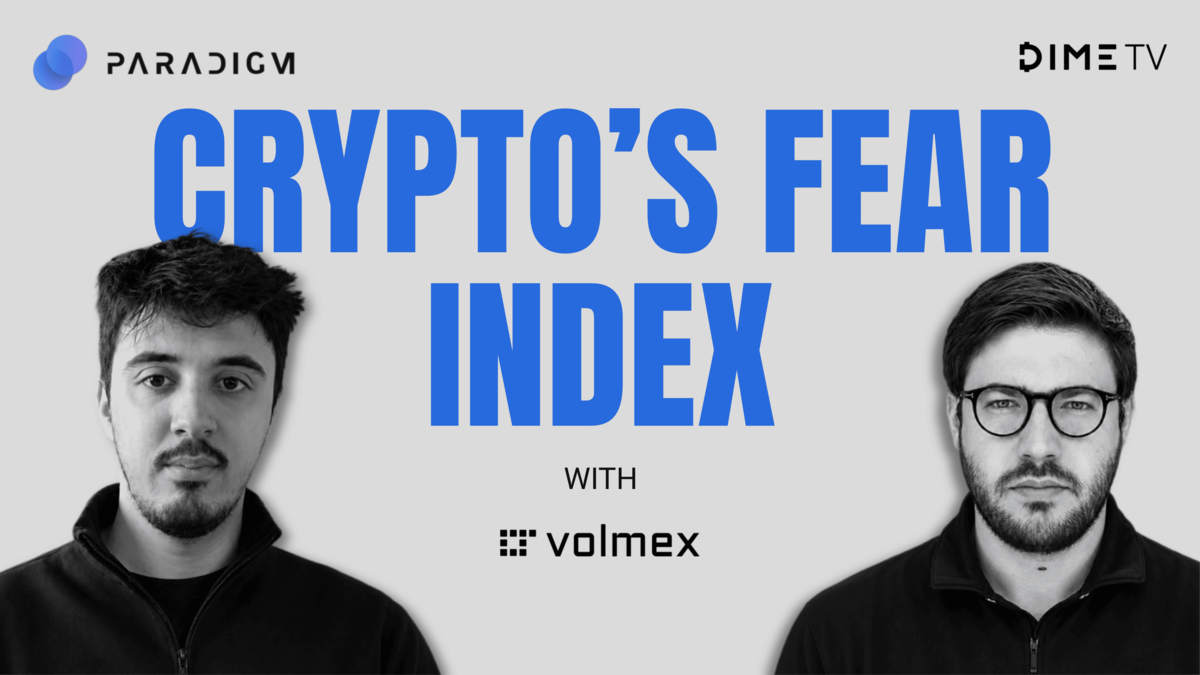
Wall Street has the VIX, its famous "fear gauge." Crypto now has its own: a Bitcoin volatility index that spikes when the market braces for big moves. The person who built the best-known one joined DimeTV to explain how it works and why it matters. Meet Cole Kennelly, founder of Volmex Labs, creator of the BVIV index.
This isn't a how-to on options mechanics. If you want the foundations, our options series covers calls, puts, the Greeks, and especially how implied volatility is priced. This is about the single number that sits on top of all that: a crypto volatility index, what it tells you, and how the market that produces it has grown up.
Watch the full episode on DimeTV with Volmex Labs founder Cole Kennelly, recorded 22 May 2026, or read the highlights below.
Featured guest
Cole Kennelly, Founder and CEO of Volmex Labs. Volmex builds crypto market indices, most notably BVIV, the longest-running and most widely referenced Bitcoin implied-volatility index, distributed on the Bloomberg Terminal, Refinitiv, and TradingView. Cole has followed the options market his whole life (his father worked at a US equity options exchange) and was an early employee at a pioneering institutional crypto firm before founding Volmex around five years ago. He joined Paradex on DimeTV to talk crypto volatility.
From the episode
BVIV is the "VIX for Bitcoin": a 30-day implied-volatility index that rises when the market expects big swings.
It is built from the global Bitcoin options market and spikes hard in crashes, like October 2025 and February 2026.
BVIV US tracks regulated US ETF options and trades a few volatility points higher, a premium for regulated, cleared structure.
Regulated US options have unlocked a new wave of retail who couldn't reach the global venues before.
Volmex runs 250+ indices and sees itself as the index infrastructure layer for a maturing crypto market.
What is a crypto volatility index?
Start with the reference point. On Wall Street, the VIX is the famous "fear gauge": a single number that captures how much movement the market expects in the S&P 500 over the next 30 days, derived from options prices. When investors are nervous and rush to buy protection, the VIX climbs. Crypto did not have an equivalent for years, and that gap is exactly what Cole set out to fill.
BVIV, the Volmex Bitcoin Implied Volatility Index, is the result. It is a 30-day implied-volatility index built from real-time Bitcoin call and put options across the major global options venues. In plain terms, it reads the options market and distils it into one number for expected volatility, a crypto fear index that rises when the market braces for turbulence and falls when things are calm. Cole describes it as the most battle-tested and widely referenced index of its kind, and it now sits on the data platforms institutions actually use.
"BVIV is a 30-day implied vol index. It goes up when the market is fearful. It generally measures expected risk, expected volatility in the crypto market."
— Cole Kennelly, Founder, Volmex Labs
What does a volatility index do in a crash?
It spikes. Because the index measures expected movement, the violent down-days are exactly when it surges. Cole points to the big crypto sell-offs, the October 2025 and February 2026 crashes, as textbook examples: as spot fell and options demand jumped, this Bitcoin volatility index rose sharply. Volmex was live through earlier shocks too, which is part of why Cole calls it the most battle-tested index in the category.
There is a crypto-specific wrinkle worth understanding. The relationship between price and volatility is strongly negative in times of fear, volatility up as price falls, but crypto can also see volatility rise during fast rallies, when greed and leverage build quickly. So the index is best understood as a measure of expected movement in either direction, not simply an inverse of price. One striking detail from the conversation: on the February 2026 sell-off, the crypto index spiked on a confluence of crypto-specific triggers while the traditional VIX barely moved, a reminder that crypto still has its own distinct risk drivers.
Why it matters for traders
A volatility index gives you a read the price chart alone cannot. If the index is climbing while price is flat, the options market is pricing in a move before it shows up in spot. That is information you can act on, whether you are hedging with options, sizing positions using the Greeks, or simply deciding how much risk is in the air.
Why is there a separate index for regulated US options?
This is where the maturing market gets interesting. Alongside the global BVIV, Volmex built BVIV US, based on options on the largest regulated US-listed Bitcoin ETF (BlackRock's IBIT). Cole's reasoning is that these are simply not the same market. Regulated ETF options trade only during US stock-market hours rather than around the clock, they clear through a regulated structure, and they are not fungible with the global crypto options market.
The result shows up in the numbers: BVIV US has been trading a few volatility points above the global BVIV. Cole attributes that gap to a premium for regulated, cleared, transparent structure, the wings of the options curve are a little more expensive when a large regulated clearing house stands behind them. Tracking the spread between the two indices is itself a useful signal of how the regulated and global markets are pricing risk differently.
Want to trade the volatility these indices measure? Paradex offers BTC and ETH options from a single self-custodial account, with live Greeks and deep liquidity built to fill.
Has regulated access finally brought retail into crypto options?
For years the knock on crypto options was that there was no retail. Cole thinks regulated US products are changing that. Because Bitcoin ETF options sit inside mainstream brokerage apps, a large group of US retail traders, the same crowd already active in zero-day equity options through familiar brokers like Robinhood, can now get Bitcoin volatility exposure without ever touching an offshore venue.
That has consequences for market structure. Cole notes the behaviour differs between the two worlds: the global venues skew toward hedging from miners and large holders who can post Bitcoin directly, while the regulated ETF options have drawn more short-dated, retail-style flow from brokerage accounts. Open interest in the regulated ETF options has grown dramatically since their late-2024 launch, to the point of rivalling the long-established global venue, a remarkable shift in roughly eighteen months. It is the same demand that newer onchain venues are built to meet, whether through perpetual options or transparent live market data.
Where does a crypto index company go from here?
Cole's ambition is bigger than one index. Volmex already runs more than 250 indices, implied-volatility, realized-volatility, rate, and correlation indices across Bitcoin, Ethereum, and other major assets, plus a full term structure of tenors. He frames the index business as the quiet infrastructure layer beneath everything else: not as visible as an exchange, but just as important, the way established index providers underpin trillions in traditional products. It is a view of crypto's derivatives landscape as serious financial infrastructure, not a casino.
The throughline is legitimacy. Distribution on the Bloomberg Terminal, which reaches hundreds of thousands of professional users, turned the index from something Cole had to explain into something institutions can simply pull up mid-call. That credibility, combined with new ways to access the data, from prediction-market contracts to forthcoming tradable products, is what he believes will make transparent volatility benchmarks a foundation of the maturing crypto market. It is the same maturing market that Paradex is built for, where institutional-grade infrastructure increasingly underpins what retail can use too.
What is the one thing to take away?
Crypto now has a real fear gauge. A volatility index turns the entire options market into a single, readable number, and the fact that crypto has a battle-tested one, distributed on the same terminals professionals use for the VIX, is a sign of how far the market has matured. Whether you trade volatility directly or just want to understand the risk in the air, the crypto VIX is worth watching. And when you are ready to act on a view, options are the instrument that lets you trade volatility itself.
Frequently asked questions
The crypto VIX refers to a Bitcoin volatility index that works like Wall Street's VIX, but for crypto. Volmex's BVIV is the best-known example: a 30-day implied-volatility index derived from real-time Bitcoin options that rises when the market expects big price swings, especially during fear-driven sell-offs.
BVIV is the Volmex Bitcoin Implied Volatility Index, a 30-day measure of expected Bitcoin volatility built from the global Bitcoin options market. It is the longest-running and most widely referenced crypto volatility index, and is available on data platforms including the Bloomberg Terminal, Refinitiv, and TradingView.
It spikes. A volatility index measures expected price movement, so during sharp sell-offs like the October and February 2026 crypto crashes, BVIV rose sharply as options demand and fear increased. It is strongly negatively correlated with price during extreme fear, though it can also rise in fast rallies.
BVIV tracks the global Bitcoin options market and runs continuously. BVIV US is built from regulated US-listed Bitcoin ETF options (IBIT options), which trade only during US market hours and tend to price a few volatility points higher, reflecting a premium for regulated, cleared, transparent structure.
Volmex Labs builds crypto market indices. It is best known for BVIV, the Bitcoin volatility index, and runs a family of over 250 volatility, realized-volatility, rate, and correlation indices across major crypto assets, distributed through platforms like the Bloomberg Terminal and used to track and trade crypto volatility.
About DimeTV
DimeTV is the institutional crypto-derivatives show from Paradex, the onchain exchange for perpetual futures and crypto options incubated by Paradigm. Each episode brings on the founders, traders, and builders shaping crypto market structure, from leading market makers and OTC desks to volatility-index and options specialists, for candid conversations on options, perpetuals, volatility, and where digital-asset derivatives go next.
This episode, released 22 May 2026, features Cole Kennelly, Founder and CEO of Volmex Labs, on BVIV, the crypto VIX, and how the market measures fear. Thanks to Cole for joining us. If you found this useful, share it with someone tracking crypto volatility, and follow DimeTV on X for new episodes with the people who actually move these markets.
Trade the volatility these indices measure. Open Paradex for BTC and ETH options, perps, and spot from one self-custodial account, built on the institutional liquidity of the team behind Paradigm.
This content is for informational purposes only and does not constitute financial, investment, or trading advice. Trading options, perpetuals, and other crypto derivatives involves substantial risk, including the loss of premiums paid and, on sold positions, losses beyond the premium received. Volatility indices and related products can move sharply and unpredictably. Past performance is not indicative of future results. Do your own research before trading.
References to third-party indices, products, and platforms are for context and do not imply any endorsement or partnership. Access to Paradex may be restricted in certain jurisdictions. Verify your local regulations before using the platform.
Quotes are drawn from the DimeTV episode and have been lightly edited for clarity and length. This article reflects the views of the guest and does not represent investment advice or the views of Paradex.



.svg)

