The next phase of crypto derivatives may be the most consequential yet: bringing real-world assets, stocks, commodities, and the structured strategies built on them, on-chain, and opening them to people who could never reach a private bank. That is the future a fifteen-year derivatives veteran sees taking shape, and it is what we explored on DimeTV with Pravin Pathmanathan, Senior Trader at Flowdesk.
This is not a how-to on options mechanics. If you want that, our options series covers calls, puts, the Greeks, and pricing end to end. This is the view from an OTC derivatives desk: how crypto options grew into a professional market, and why the real growth from here runs through tokenized real-world assets.
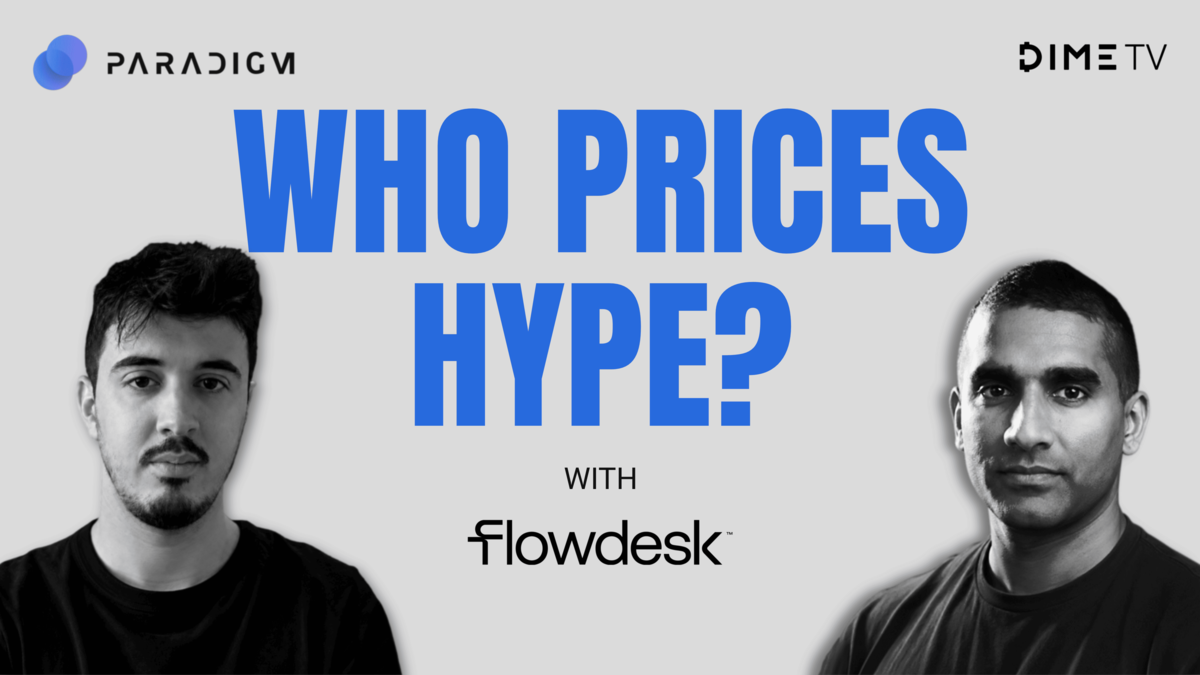
Watch the full episode on DimeTV with Flowdesk's Pravin, recorded 18 May 2026, or read the highlights below.
Featured guest
Pravin Pathmanathan, Senior Trader at Flowdesk. Flowdesk is a full-service digital-asset trading and technology firm, regulated as a Digital Asset Service Provider in France, that provides market making and OTC liquidity across spot and derivatives. Pravin spent around fifteen years trading equity derivatives in traditional finance, from European single-stock and index options to commodity and cross-asset volatility, before moving into crypto options and joining Flowdesk to build out its OTC derivatives desk. He joined Paradex on DimeTV to talk about where the options market goes next.
From the episode
Crypto BTC and ETH options have become a genuinely professional, efficient market, often more liquid under stress than traditional markets.
The mechanics mirror equity options closely. The real wrinkle for newcomers is inverse and cash-settled contracts.
Growth is moving off the screen into structured products and OTC flow, the same path traditional options markets took.
The big unlock ahead is tokenized real-world assets: options on tokenized equities and commodities.
Vault-traded funds (VTFs) could open structured strategies, like a tokenized stock plus a covered call, to investors who can't reach a private bank.
How did crypto options become a serious market?
When Pravin first looked at crypto options around 2018 and 2019, two things drew him in: the volatility, and, more strikingly, the volume. He recalls that listed Bitcoin options activity was already rivalling the European index-options market he traded in traditional finance, and the block sizes changing hands were comparable to or bigger than what he saw on established venues. For an options market maker, that combination, an early market with real flow and wide spreads, is exactly where you want to be.
Years later, his verdict is blunt: the BTC and ETH volatility market is now genuinely professional and efficient. It has been tested across wildly different regimes, from extremely high volatility to calm, and the liquidity has held up each time. A market that has survived that range of conditions has earned a level of trust.
"I find the BTC and ETH volatility market super efficient. Even in a very stressed market, there is good liquidity, which is a really good thing for an institutional player to know."
— Pravin Pathmanathan, Flowdesk
Why does liquidity hold up when markets are stressed?
This is the counterintuitive part. In traditional markets, liquidity often vanishes exactly when you need it, as makers widen spreads or step away during a sell-off. Pravin's experience in crypto options is close to the opposite: even on violent days, there is still a market to trade. He frames it as good and bad. Bad for a market maker, because the competition is fierce and very efficient. Good for everyone else, because an institution evaluating crypto wants to know its liquidity will be there in a crisis, not just on a quiet afternoon.
That resilience is not luck. It comes from a deep, competitive set of professional market makers who keep quoting through the chaos, and from steady two-way flow that lets them offset risk. For a trader sizing up the asset class, dependable fills under stress is one of the strongest signals that a market has matured. It is also the quality that the most liquid onchain venues, including Paradex, compete hardest on.
Are crypto options really that different from equity options?
For all the mystique, Pravin's answer is mostly no. The volatility dynamics behave like equity-index options: when the market falls, volatility tends to rise, and vice versa, a pattern he says holds the large majority of the time in the current regime. The skew of the volatility curve works in familiar ways. If you have traded equity options, most of your intuition transfers directly.
The genuine wrinkle is the inverse and cash-settled nature of many crypto contracts. The key question a newcomer has to keep straight is whether they are making money in crypto terms or in dollar terms. Get your head around that, and Pravin argues people tend to overcomplicate the rest. The contract mechanics are not exotic; they are the same cash-settled mechanics found across other markets.
Two backgrounds, two styles
Pravin notes a difference in style between traders entering crypto options from different backgrounds. Those from an equity background, like him, often gravitate to cleaner structures such as call spreads. Those from an FX background tend to reach for more exotic, structured payoffs, knock-ins, knock-outs, and tailored strikes. Neither is better; both, he notes, are pulling crypto options toward a richer structured-product market, which is where he sees the real growth.
Where is the growth actually happening?
Not in the listed vanilla options most people watch. Pravin's read is that crypto options are following the exact path traditional options markets took: the visible, listed contracts increasingly become derivative of the much larger structured-product and OTC flow happening off-screen. Flowdesk sees this directly on its OTC desk, where clients doing the biggest size want sophisticated, structured products rather than plain vanilla trades.
A concrete example from the past year: options on a leading altcoin with deep off-exchange demand. Because Flowdesk had both long-term holders selling covered calls for yield and funds buying upside exposure, it could build a robust two-way market and price competitively, a snowball effect where more flow produces better pricing, which attracts more flow. That is the structured, relationship-driven market institutions recognise from traditional finance.
Want to trade options on a venue built for institutional-grade liquidity? Paradex offers BTC and ETH options from a single self-custodial account, with deep liquidity designed to fill rather than sit in the book.
Ask Pravin what excites him most, and the answer is unambiguous: the tokenized world. After a decade of blockchain being used mostly to trade crypto-native tokens, he sees the next phase as bringing real-world assets, tokenized equities, commodities, and the derivatives on top of them, onto the same rails. RWA options are simply options on those tokenized assets: the right to buy or sell a tokenized stock or commodity at a set price, using the same mechanics as any other option.
The reason it matters is access. The liquidity in the underlying tokenized assets is increasingly there. Once you can trade a tokenized equity with tight pricing, demand for derivatives on it follows naturally, just as it always has when an underlying becomes liquid. Bringing TradFi-style options on-chain is a stated part of where Paradex is heading, alongside its expansion into spot and real-world-asset trading.
A note on timing: tokenized-equity and RWA options are an emerging category and part of Paradex's roadmap, not a live Paradex product today. The discussion here is about where the market is heading. What is live now is Paradex's perpetual and options markets on crypto, and its yield-generating vaults.
Could vault-traded funds open structured strategies to everyone?
This is the idea that drew the most energy in the conversation. In traditional finance, structured products are effectively gated. As Pravin puts it, if you hold a million dollars of a single stock but you are not a private-bank client, you have almost no practical way to run a yield strategy against it. The structured-product world is built for the elites.
Tokenization can change that. If a stock is tokenized, a strategy can be wrapped in an onchain vault: a vault-traded fund, or VTF, a concept Pravin and our host built out together on the show. Imagine a vault that holds a tokenized equity and systematically sells covered calls against it, then issues a token representing your share of that strategy. Suddenly a structure once reserved for high-net-worth clients becomes something a much broader group of investors can simply hold. Pravin sees this, alongside tokenized RWAs, as potentially the next evolution of the ETF.
Paradex already runs the live building block this vision needs: onchain, yield-generating vaults. Today GigaVault generates yield from market-making and trading activity across Paradex markets. The same vault machinery is what a future VTF-style product would be built on, which is why the tokenized-strategy thesis is worth watching closely from where Paradex sits.
What is the one thing to take away?
Crypto options have quietly grown up. The market is professional, liquid even under stress, and structurally similar to the equity options Pravin traded for fifteen years. The frontier now is not novelty for its own sake; it is using this infrastructure for something that matters: bringing real-world assets and the structured strategies built on them on-chain, and opening access to investors who were always locked out. That is the shift worth tracking, and it runs straight through tokenization and vaults.
Frequently asked questions
RWA options are options contracts on tokenized real-world assets, such as tokenized equities, commodities, or other off-chain instruments represented on a blockchain. They let traders hedge or generate yield on tokenized stocks and similar assets using the same option mechanics used in crypto and traditional markets.
A vault-traded fund is an emerging idea in which an onchain vault runs a defined strategy, for example holding a tokenized stock and selling covered calls against it, and issues a token representing a share of that strategy. It aims to give smaller investors access to structured strategies that, in traditional finance, are usually reserved for private-bank clients.
According to Flowdesk's Pravin, crypto BTC and ETH options have stayed surprisingly liquid even during sharp sell-offs, unlike many traditional markets where liquidity dries up under stress. He attributes this to a competitive set of professional market makers and consistent two-way flow across volatility regimes.
Mechanically they are very similar. The main wrinkle is inverse and cash-settled contracts, where a trader must track whether profit and loss is measured in crypto or in dollars. Volatility behaviour, such as volatility rising when the market falls, mirrors equity-index options closely.
Flowdesk is a full-service digital-asset trading firm that provides market making and over-the-counter (OTC) derivatives liquidity, including options across a wide range of tokens and structured products. It is regulated as a Digital Asset Service Provider in France and runs a dedicated OTC derivatives desk.
About DimeTV
DimeTV is the institutional crypto-derivatives show from Paradex, the onchain exchange for perpetual futures and crypto options incubated by Paradigm. Each episode brings on the founders, traders, and builders shaping crypto market structure, from leading market makers and OTC desks to volatility-index and options specialists, for candid conversations on options, perpetuals, volatility, and where digital-asset derivatives go next.
This episode, released 18 May 2026, features Pravin Pathmanathan, Senior Trader at Flowdesk, on RWA options, tokenized derivatives, and vault-traded funds. Thanks to Pravin for joining us. If you found this useful, share it with someone exploring crypto options, and follow DimeTV on X for new episodes with the people who actually move these markets.
This content is for informational purposes only and does not constitute financial, investment, or trading advice. Trading options, perpetuals, and other crypto derivatives involves substantial risk, including the loss of premiums paid and, on sold positions, losses beyond the premium received. Past performance is not indicative of future results. Do your own research before trading.
References to tokenized real-world assets, RWA options, and vault-traded funds describe an emerging and evolving market, including features that may be on Paradex's roadmap rather than currently available. Availability of products varies and some may not be live. Access to Paradex may be restricted in certain jurisdictions. Verify your local regulations before using the platform.
Quotes are drawn from the DimeTV episode and have been lightly edited for clarity and length. This article reflects the views of the guest and does not represent investment advice or the views of Paradex.



.svg)

